“How much should I spend on Facebook ads?” is usually the first question a small business owner asks me, and the honest answer is that nobody can give you a good number without three or four of your own. A sensible Facebook ads budget for small business is not a figure you copy from someone else. It is one you work out backwards from what a customer is worth to you.
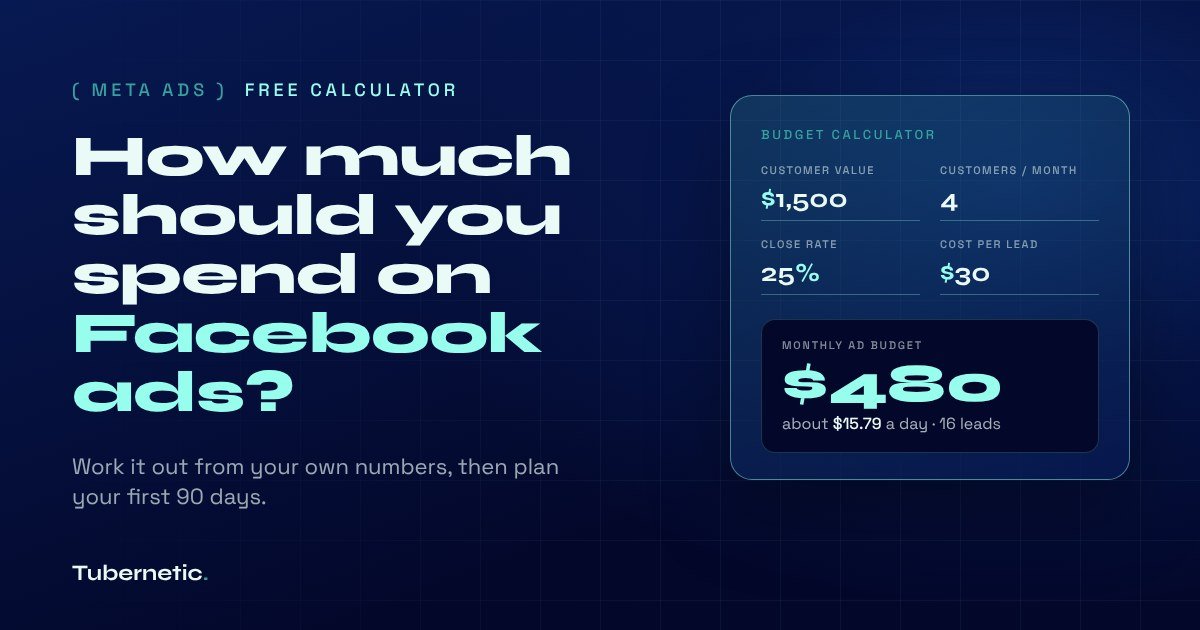
Short answer: work it out from your own numbers. Decide how many new customers you want a month, divide by how many enquiries usually turn into customers, then multiply by what a lead costs you. Four customers at a one in four close rate and $30 per lead means 16 leads, or about $480 a month. Use the calculator below to run yours.
This guide shows you how to do that, gives you a free calculator to run your own numbers, and lays out a realistic plan for your first 90 days so you are not guessing.
Why Facebook ads budget advice is all over the place
Search for this and you will find advice that ranges from a few dollars a day to thousands a month. Both ends can be right for someone. A national online store and a local physio are not playing the same game, and a budget that works for one would be a waste or a starvation diet for the other.
What actually decides your budget is a handful of numbers that are specific to your business:
- What a new customer is worth to you. A one off $80 job and a $3,000 project cannot carry the same ad cost.
- How many enquiries turn into customers. If you close one in two, you need half as many leads as someone who closes one in four.
- What a lead costs you. This changes with your industry, location, offer and season, which is why copying someone else’s number rarely works.
- How many customers you can actually handle. There is no point paying for leads you cannot serve.
How to work out a Facebook ads budget for small business
Here is the formula. It takes about two minutes with a calculator, or seconds with the one below.
- Customers you want each month ÷ your close rate = leads you need each month.
- Leads you need × cost per lead = your monthly ad budget.
- Monthly budget ÷ 30.4 = your average daily budget.
Say a new customer is worth $1,500 to you, you want four of them a month, and roughly one in four enquiries becomes a customer. You need 16 leads. If a lead costs you around $30, that is about $480 a month, or a little under $16 a day. Each new customer costs you about $120 in ads, which is easy to justify against $1,500.
The same maths also tells you when ads will not work. If a lead costs $60 and you only close one in ten, each customer costs $600 in ads. If a customer is only worth $400 to you, the answer is not a bigger budget. It is a better offer, a better page or better follow up first.
Meta ads budget calculator: try your own numbers
Change any of the four boxes and the results update straight away. If you have never run ads before, leave cost per lead at the starting figure, run a short test, then come back and put in what you actually see.
Free tool
Meta ads budget calculator
Put in your own numbers. Everything is worked out in your browser and nothing is sent anywhere.
This is a planning estimate, not a promise. It covers ad spend only, not management fees, and real costs per lead change with your industry, location, offer and season.
How much to spend on Facebook ads per day
Monthly budget divided by roughly 30 gives you a daily figure, but there is one more thing worth knowing before you settle on it: Meta’s learning phase.
According to Meta, an ad set generally needs about 50 results within seven days to exit the learning phase and settle down. If you are optimising for leads, the daily budget that gets you there is roughly cost per lead × 50 ÷ 7. At $30 a lead that is about $214 a day, which is far more than most local businesses spend.
That is fine. Plenty of small accounts never leave learning and still bring in steady, profitable enquiries. What it means in practice:
- Keep it to one campaign with one or two ad sets, so your budget and data are not split thin.
- Judge results over weeks, not days. A slow Tuesday tells you nothing.
- Avoid big daily edits. Large changes to budget, audience or creative restart the learning process.
Also know that a daily budget is an average, not a hard cap. Meta’s current rules allow it to spend up to 75% over your daily budget on days with better opportunities, but never more than seven times your daily budget across a Sunday to Saturday week. So a $20 daily budget can show $35 on one day and less on others, while the week stays within $140.
Is $10 a day enough for Facebook ads?
It can be, for the right business. $10 a day is about $300 a month. If your leads cost $20, that is around 15 enquiries a month, which can be plenty for a tradie, a local clinic or a service business where one customer is worth hundreds or thousands.
Where $10 a day struggles:
- When leads are expensive. At $60 a lead you would get about five a month, which is too few to tell a good ad from a lucky one.
- When you split it across several ad sets or audiences. Each one gets too little to learn anything.
- When you need results fast. Small budgets need more patience to show a pattern.
So $10 a day is a reasonable place to start testing if the calculator shows the numbers can work. It is rarely enough to scale on.
A realistic Facebook ads budget plan for your first 90 days
Month 1: test and learn
Treat the first month as paying for information, not as a campaign you judge on profit. Run one campaign with the Leads objective, two or three different ads, and working conversion tracking. The goal is your real cost per lead and an early sense of which ad people respond to.
Month 2: cut what is not working
Turn off the weakest ads, keep the best one or two, and try one new variation at a time. Now look past cost per lead to quality: how many of those enquiries actually turned into customers? Put your real numbers into the calculator and you will know what budget makes sense.
Month 3: scale carefully
If the numbers work, raise the budget in modest steps and give each change a few days before the next one, rather than doubling it overnight. A common rule of thumb is around 20% at a time. If results hold, keep going. If cost per lead jumps, go back a step.
Ad spend is not the whole cost
When you plan a Facebook ads budget for small business, remember the money that goes to Meta is only one part. Depending on how you run it, you may also be paying for:
- Management. Your time, or an agency or freelancer’s fee. This is billed separately from what you pay Meta.
- Creative. Images and short videos that are good enough to stop the scroll.
- A landing page that converts. Sending paid traffic to a weak page wastes the budget before it starts.
Budget for the whole picture. A smaller ad spend with a strong page and good creative usually beats a bigger spend sent to a homepage. If clicks are coming in but enquiries are not, read why your Facebook ads get clicks but no enquiries before adding more money.
Budget mistakes that waste money
- Boosting posts instead of running proper campaigns. The Boost button is built for reach and engagement, not enquiries.
- Spreading a small budget across many ad sets. Each one gets too little data to improve.
- Changing things every day. Every big edit sends the ad set back to learning.
- Judging after three days. Give it a few weeks of data, especially on a small budget.
- Raising the budget before tracking works. If Meta cannot see your leads, more money just buys more guessing.
Want help setting your budget?
If you would rather not do the maths and the testing yourself, this is exactly the kind of work I do: set the budget from your numbers, build the campaign and landing page together, and report on cost per customer, not just clicks. You can see my Meta ads management rates (ad spend is paid separately to Meta), or send me your numbers and I will tell you honestly whether ads make sense for you right now.
Frequently asked questions
What is the minimum budget for Facebook ads?
Meta sets a minimum daily budget that depends on your currency and what you are optimising for, and Ads Manager shows it when you set up the ad set. In practice the useful minimum is higher than the technical one: it is whatever gets you enough leads each month to see a pattern. Run your numbers in the calculator above to see where that is for you.
How much should I spend on Facebook ads per month?
Multiply the number of leads you need by what a lead costs you. Leads needed comes from the customers you want divided by your close rate. For many local service businesses that lands somewhere in the hundreds a month rather than the thousands, but your own numbers decide it.
Is $500 a month enough for Facebook ads?
It is enough to test properly for many small businesses. At $25 per lead it buys around 20 leads. Whether that is enough depends on how many of those leads you close and what each customer is worth to you.
How much do Facebook ads cost in Australia?
There is no single price. You set the budget, and what you get for it depends on your industry, location, audience, offer and season. The most reliable figure is the cost per lead from your own test campaign, which is why the first month matters so much. Meta’s own overview of Facebook and Instagram ads pricing explains the factors that move the price.
Why did Meta spend more than my daily budget?
Daily budgets are an average, not a hard limit. Meta may spend up to 75% over your daily budget on days with better opportunities, but it will not spend more than seven times your daily budget across a calendar week.
Should I use a daily or lifetime budget?
For ongoing lead generation, a daily budget is simpler to manage and easier to adjust in steps. A lifetime budget suits campaigns with a fixed end date, such as a sale or an event, where you want Meta to pace a set amount across that period.